
Rinsing is not cleaning
A garden hose moves loose dust, leaves and fresh spills. It does not remove the grime that has bonded to concrete or settled deep in its pores. That is why a hosed driveway looks clean while wet, then dries back to the same gray, blotchy color within an hour.
Concrete is porous and slightly rough. Dirt, oil, tire residue and organic film work into those tiny openings and cling there. Getting them out takes three things a hose does not provide: a cleaner that loosens the bond, time for it to work, and enough focused energy to flush the pores.
Pressure and flow, explained simply
Cleaning power comes from both pressure, how hard the water hits, and flow, how much water carries dirt away. A typical garden hose has decent flow but low pressure. It pushes loose material around but does not break the grip of embedded dirt.
A pressure washer adds pressure through a small nozzle. That helps, but on its own it creates new problems. A narrow, intense stream held too close can etch concrete and leave visible lines, the zebra striping you see on many DIY driveways. More pressure is not always better. Our guide to safe pressure for each surface covers the limits.
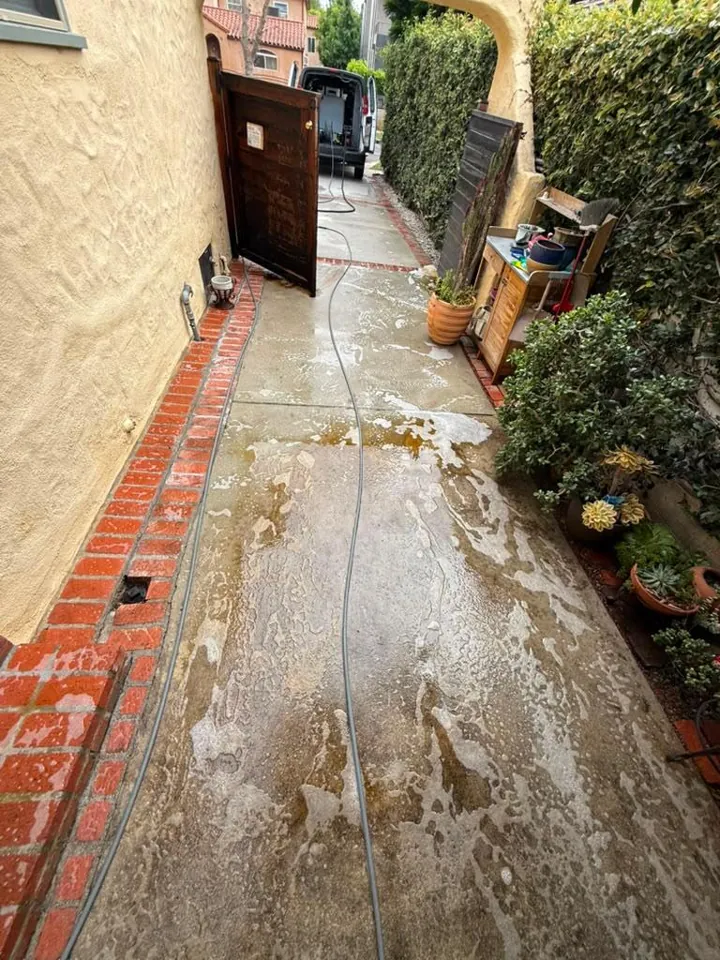
The parts that actually do the cleaning
Pre-treatment comes first. A cleaner suited to the stain, whether a degreaser for oil or a solution for organic growth, is applied to the dry or lightly wetted surface. It loosens the bond between dirt and concrete.
Dwell time is next. The solution needs several minutes to work, without drying. On a hot day in the Valley that can mean working in smaller sections or in the morning.
Then comes even mechanical action. A rotary surface cleaner spins two or more nozzles inside a hood at a fixed height, so every part of the slab gets the same treatment. It cleans faster and more evenly than a wand and avoids striping. A final rinse, from the top down, carries away the loosened dirt.
When a hose is enough
A hose is the right tool for regular upkeep. Rinsing off fresh dust after a Santa Ana wind event, washing away jacaranda petals before they stain, or flushing pollen off a patio in spring all work fine with a hose and a stiff push broom.
Scrubbing with a broom and a bucket of mild detergent also helps on small areas like a front step. It will not match a professional clean on a whole driveway, but it can keep a clean surface looking good much longer.
A good rule of thumb: if the dirt comes off when you run a finger across it, a hose will move it. If the surface stays gray after the water dries, the dirt is in the pores and needs a deeper method.
Common mistakes when stepping up from a hose
People often jump from a hose straight to the narrowest nozzle on a rented machine and start blasting. That etches the surface, strips sealer and can make it darker and dirtier faster, because rough concrete holds more dirt.
Other mistakes are skipping pre-treatment, cleaning in strips instead of overlapping passes, and rinsing bottom to top so dirty water runs over finished areas. Also watch where the water goes. Los Angeles Municipal Code section 64.70.02 prohibits discharging untreated wash water from paved-surface washing into the storm drain system.
Finally, do not judge the result while the concrete is wet. Wet concrete always looks darker and more even. Let it dry fully, then check for missed spots, stripes or lap marks, and spot-treat those before you put the equipment away.
Doing it yourself or hiring it out
If you want to try it, renting a machine with a surface cleaner attachment and buying a proper concrete cleaner will get you far closer than a hose. Our guide on renting versus hiring compares the two honestly.
If you would rather hand it off, as of October 2026 driveway cleaning on our calculator is $0.50 per square foot, with a $195 minimum per visit. At Say Wash It we use pre-treatment, dwell time and a surface cleaner on every flat concrete job, and the flat price is confirmed before work begins.
Key points
Rinsing is not cleaning
A garden hose moves loose dust, leaves and fresh spills. It does not remove the grime that has bonded to concrete or settled deep in its pores. That is why a hosed driveway looks clean while wet, then dries back to the same gray, blotchy color within an hour.
The parts that actually do the cleaning
Pre-treatment comes first. A cleaner suited to the stain, whether a degreaser for oil or a solution for organic growth, is applied to the dry or lightly wetted surface. It loosens the bond between dirt and concrete.