
Your paint probably isn't faded
Stucco is porous. It holds airborne dust, exhaust residue and mineral film from sprinkler overspray, and it holds it evenly, which is exactly why the whole wall reads as faded rather than dirty. Wash a test patch and the difference is usually obvious immediately.
Soft washing, not pressure
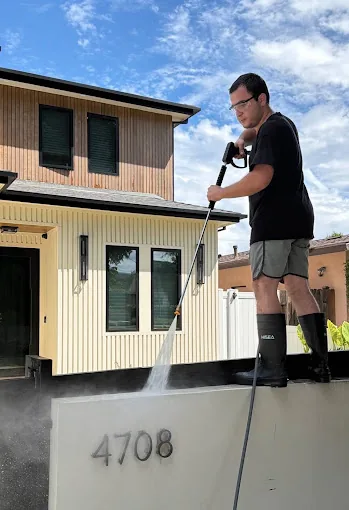
A full-strength pressure washer against stucco drives water behind the finish and can blow out the surface entirely. We use low pressure and a solution that breaks down mildew and algae chemically, then rinse. It gets cleaner and stays clean longer, because the growth is killed rather than knocked off.
What it costs against repainting
Exterior painting on an average Los Angeles home runs into five figures. A full house wash is a small fraction of that and buys years before painting is genuinely necessary. If you're preparing to sell, it's the highest-return exterior work available.
Every surface, handled correctly
Stucco, painted siding, brick, fibre cement and painted wood each behave differently and each gets a different approach. Using one method on all of them is how damage happens.
Soft washing is the whole method, not a marketing word
A pressure washer strong enough to clean concrete will destroy a stucco wall. The finish coat carrying the colour and the weather resistance is thin, porous and the only thing protecting the layers beneath it. Force it and the texture flattens, the colour hardener comes off, and in bad cases the surface blows away entirely leaving exposed base coat.
Soft washing inverts the method. A cleaning solution is applied at roughly garden-hose pressure and left to dwell long enough to break down mildew and algae chemically. Then it is rinsed gently. The detergent does the cleaning; the water only carries it away.
That is not a compromise. It cleans more completely than pressure does, because it kills the organism at root level rather than shaving off the visible layer, and the wall stays clear for considerably longer.
The damage nobody sees until later
Almost every stucco wall in Los Angeles carries hairline cracking from seismic movement and daily thermal cycling. Those cracks are normally harmless. Forcing pressurised water into them drives moisture behind the wall, where it has nowhere to go and no way to dry.
A dirty wall is cosmetic. Water inside a wall assembly is not, and it usually announces itself months later as a stain on interior drywall or a soft spot in trim. This is the real reason we do not use high pressure on a house, and it is worth asking any company you call what pressure they use on stucco.
Every surface behaves differently
Stucco dominates Los Angeles housing and takes the gentlest approach. Fibre-cement and painted wood siding clean well but need attention to lap joints where water can drive upward behind the boards. Brick is durable but its mortar joints are not, and older mortar blows out under pressure that the brick shrugs off.
Eaves and soffits hold the heaviest cobweb and wasp-nest accumulation on the whole property, and they are the section most companies skip because they require working overhead from a ladder rather than from the ground.
Painted trim and older paintwork get assessed before we start. Paint that is already failing will not survive any wash, and we would rather tell you that up front than hand you a bill and an argument.
What Los Angeles actually deposits on your walls
Inland and Valley properties collect a fine grey film of brake dust, exhaust particulate and atmospheric dust. It settles evenly across every elevation, which is exactly why it reads as faded paint rather than dirt.
Coastal and South Bay properties get salt instead. Airborne salt is hygroscopic — it pulls moisture out of the air and holds it against the surface, which is why coastal walls stay damp and grow algae continuously, and why metal fixtures and railings corrode faster within a mile of the water.
North-facing walls anywhere in the basin are the worst case. In a marine layer they may not fully dry for weeks, and permanently damp porous stucco grows algae year round. That is why one side of a house can look green while the others look fine. It is a moisture problem, not a paint problem.
After fire season there is ash. Ash is alkaline and etches painted and masonry surfaces if it sits through a rain, which makes post-fire cleaning genuinely time-sensitive rather than cosmetic.
What we do to protect everything that is not the wall
Plants are pre-wetted before any solution goes up and rinsed again afterwards. Wet foliage does not absorb cleaning solution; dry foliage does. Skipping that step is how landscaping gets burned.
Windows, light fixtures, outlets, irrigation heads and exterior electrical are covered or avoided. Doors and windows get checked as closed before we start, because older frames do not always seal the way people assume.
None of this is an upsell. It is most of the setup time, and it is the difference between a house wash and a mess.
What it costs against repainting, honestly
Exterior painting on an average Los Angeles home runs into five figures. A full house wash is a small fraction of that, and on most stucco it recovers the colour completely because the colour was never gone in the first place.
Wash a test section before you commit to painting. If the colour returns, your paint is fine and you have a cleaning job. If it does not, you have genuine UV fading and painting is the right answer — and the surface has to be clean before painting anyway, so nothing is wasted.
Most single-storey homes take two to three hours. Two-storey and larger properties take longer, and you get that window with your quote rather than after.
What usually gets added at the same time
The roof, if streaking is visible from the street — those black streaks are algae and they shorten roof life by holding moisture against the shingles. Gutter faces, which are the one surface that stays visibly dirty after a house wash and makes the whole job look unfinished. And the driveway, because clean walls make grey concrete look worse than it did.
Pre-sale and pre-paint jobs are where this matters most. If the photographs are being taken next week, the exterior should be finished, not partially finished.
Common questions
Will it strip or chip my paint?
Not with soft washing. Low pressure and the correct detergent are gentler on a painted surface than a garden hose at full pressure. The stripping and chipping people have seen comes from high-pressure equipment used on a surface that could not take it. Paint that is already failing or flaking will not survive any wash — we assess that before starting and tell you.
Is it safe for stucco?
Yes, when it is soft washed. Stucco is the dominant surface in Los Angeles and the one most commonly damaged by companies running a single pressure setting all day. We clean it at roughly garden-hose pressure and let the cleaning solution do the work. If a company quotes you a high PSI figure for stucco, that is your signal to keep looking.
What about my plants?
They are pre-wetted before any solution is applied and rinsed again afterwards. Wet foliage does not take up cleaning solution the way dry foliage does. Delicate or newly planted areas get covered. Tell us about anything you are particularly attached to and we will protect it specifically.
Do I need to be home?
No, provided we have access to the exterior, an outdoor spigot and an outdoor outlet, and all windows and doors are properly closed. Many customers are at work. If you are home, we would rather walk the property with you at the end.
How often should a house be washed in Los Angeles?
It depends where you are. Coastal and marine-layer properties in Santa Monica, Venice or the South Bay generally want it annually, because salt and permanent damp grow algae continuously. Inland and Valley homes usually hold for eighteen months to two years. North-facing walls anywhere need it more often than the rest of the house, and fire-season ash resets the clock regardless.
Can you do it before we list the house?
Yes, and it is the highest-return exterior work available before a sale. Book it a few days ahead of the photographer so everything is fully dry and there is time to address anything the cleaning reveals. Cleaning after listing means your photographs show the old condition for the whole campaign.